Pengembangan E-Engklek Math Game Berbasis Web dengan Pendekatan Hypothetical Learning Trajectory pada Materi Bilangan Rasional untuk Meningkatkan Kemampuan Berpikir Kritis Matematis Siswa Kelas VII SMP
DOI:
https://doi.org/10.46838/jbic.v7i2.1410Keywords:
E-Engklek Math Game, Hypothetical Learning Trajectory, Mathematical Critical Thinking, Rational Numbers, Web-Based Mathematics LearningAbstract
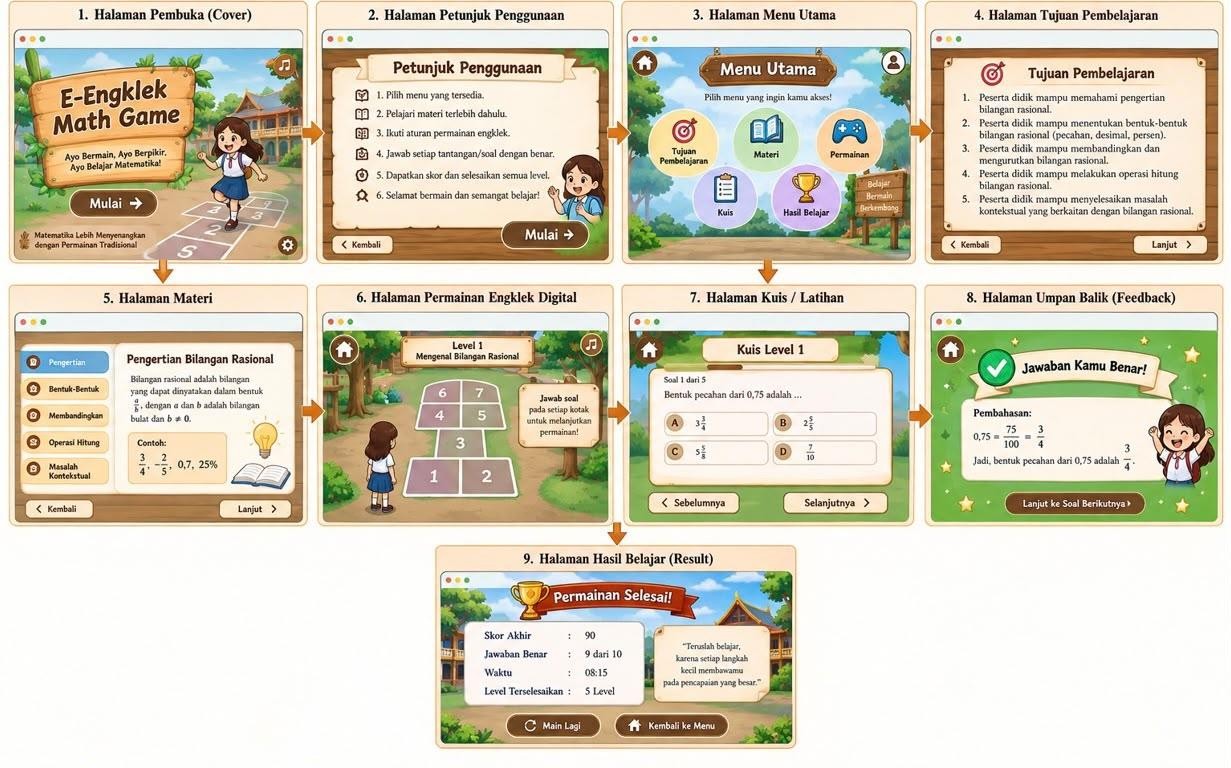
Seventh-grade students at SMP Nurul Khoir Jambi showed very low mathematical critical thinking: on an essay-type preliminary test taken by 25 students, the mean score was 31.50% of the maximum, and interpretation was the weakest indicator (3.0%). This article aims to design E-Engklek Math Game, a web-based mathematics learning game that adapts the Indonesian hopscotch game Engklek to the topic of rational numbers through a Hypothetical Learning Trajectory (HLT) approach. The study is Research and Development using the ADDIE model, and this article reports only the Analysis and Design phases. Data were collected through classroom observation, a teacher interview, a student needs questionnaire, the preliminary test, and a review of the Phase D curriculum, and were analysed using descriptive statistics and qualitative data reduction. The analysis translated the test profile and classroom conditions into four functional requirements, the most decisive being that students must state the known and asked information before calculating. The design phase produced product specifications, a mapping of game actions to rational number concepts and four critical thinking indicators, a six-stage HLT specifying predicted responses, likely errors, and planned feedback, a nine-screen storyboard, and draft evaluation instruments. The design contribution lies in using the HLT to make an interpretation step a required condition on every game square and to link hints and feedback to anticipated errors. The product has not yet been developed, validated, or tested; its validity, practicality, and effectiveness will be examined in the Development, Implementation, and Evaluation phases.
References
Ardiansyah, A. S., Anwar, M., Prasetya, B. D., Wardani, R. K., & Ratnawati, N. (2023). Inovasi Bahan Ajar Etnomatematika Melalui Permainan Engklek Dengan Game Based Learning Terhadap Kemampuan Berpikir Kreatif Peserta Didik. Jurnal Lebesgue: Jurnal Ilmiah Pendidikan Matematika, Matematika dan Statistika, 4(2), 1344–1357. https://doi.org/10.46306/lb.v4i2.375
Branch, R. M. (2009). Instructional design: The ADDIE approach. Springer. https://doi.org/10.1007/978-0-387-09506-6
Clements, D. H., & Sarama, J. (2004). Learning trajectories in mathematics education. Mathematical Thinking and Learning, 6(2), 81–89. https://doi.org/10.1207/s15327833mtl0602_1
Facione, P. A. (2015). Critical thinking: What it is and why it counts. Insight Assessment.
Fatmawati, R., & Siregar, T. J. (2026). Pengaruh model game-based learning terhadap kemampuan berpikir kritis matematis siswa pada materi bangun ruang sisi datar. Jurnal Pendidikan Matematika dan Sains, 14(1), 131–140. https://doi.org/10.21831/jpms.v14i1.93601
Firmasari, S., Herman, T., & Nurlaelah, E. (2023). The evolution of Indonesian curriculum: Hypothetical learning trajectory for mastery of mathematical and computational thinking. JRAMathEdu (Journal of Research and Advances in Mathematics Education), 8(4), 213–224. https://doi.org/10.23917/jramathedu.v8i4.2116
Fitri, W., Maimunah, M., & Suanto, E. (2023). Analisis kemampuan berpikir kritis matematis siswa kelas IX SMP Negeri 20 Pekanbaru pada materi persamaan garis lurus. PRISMA, Prosiding Seminar Nasional Matematika, 6, 592–600.
Fitria, F., Sunismi, S., & Fuady, A. (2024). Validity of interactive media to strengthen understanding concepts in integer class VII. Jurnal Inovasi Teknologi Pendidikan, 11(1), 69–79. https://doi.org/10.21831/jitp.v11i1.64289
Hake, R. R. (1998). Interactive-engagement versus traditional methods: A six-thousand-student survey of mechanics test data for introductory physics courses. American Journal of Physics, 66(1), 64–74. https://doi.org/10.1119/1.18809
Hartanto, R. T., Hamidah, & Kusuma, J. W. (2024). Penerapan model pembelajaran game based learning dengan quiz game Baambloze terhadap kemampuan berpikir kritis matematik siswa SMP. Prosiding Diskusi Panel Nasional Pendidikan Matematika, 10, 337–346.
Hussein, M. H., Ow, S. H., Elaish, M. M., & Jensen, E. O. (2022). Digital game-based learning in K-12 mathematics education: A systematic literature review. Education and Information Technologies, 27(2), 2859–2891. https://doi.org/10.1007/s10639-021-10721-x
Kementerian Pendidikan, Kebudayaan, Riset, dan Teknologi. (2022). Keputusan Kepala Badan Standar, Kurikulum, dan Asesmen Pendidikan Nomor 008/H/KR/2022 tentang Capaian Pembelajaran pada Pendidikan Anak Usia Dini, Jenjang Pendidikan Dasar, dan Jenjang Pendidikan Menengah pada Kurikulum Merdeka.
Mao, W., Cui, Y., Chiu, M. M., & Lei, H. (2022). Effects of game-based learning on students’ critical thinking: A meta-analysis. Journal of Educational Computing Research, 59(8), 1682–1708. https://doi.org/10.1177/07356331211007098
Melgusmayenti, & Isnaniah. (2021). Kemampuan berpikir kritis matematis siswa kelas VII SMPN 5 Bukittinggi. Al Khawarizmi: Jurnal Pendidikan dan Pembelajaran Matematika, 5(2), 102–112. https://doi.org/10.22373/jppm.v5i2.9589
Mubaraq, M. H., Kartono, & Zaenuri. (2025). Integrasi permainan tradisional engklek pada pembelajaran matematika: Studi SLR. JP2M (Jurnal Pendidikan dan Pembelajaran Matematika), 11(2), 1415–1424. https://doi.org/10.29100/jp2m.v11i2.8193
Prensky, M. (2007). Digital game-based learning. Paragon House.
Putri, R. L., Marsitin, R., & Suwanti, V. (2021). Permainan tradisional engklek untuk meningkatkan komunikasi matematis peserta didik. Jurnal Pendidikan Matematika RAFA, 7(2), 157–169.
Radityastuti, E. Y., Lukman, H. S., & Agustiani, N. (2023). Implementasi digital game-based learning untuk meningkatkan kemampuan berpikir kritis dan pemecahan masalah matematis siswa SMP. AXIOM: Jurnal Pendidikan dan Matematika, 12(1), 96–105. https://doi.org/10.30821/axiom.v12i1.16047
Rizki, F. A., & Amir, M. F. (2025). Hypothetical learning trajectory based on inquiry learning to find the volume of space. Matematika dan Pembelajaran, 13(1), 19–42. https://doi.org/10.33477/mp.v13i1.9303
Samo, D. D., Ekowati, C. K., Soko, I. P., & Ngawas, K. R. (2023). Pengaruh penggunaan media pembelajaran matematika berbasis website terhadap peningkatan hasil belajar siswa: Meta-analisis. Jurnal Riset Pendidikan Matematika, 10(1), 89–101. https://doi.org/10.21831/jrpm.v10i1.49357
Sapitri, D., & Meiliasari. (2026). Systematic literature review: Kemampuan berpikir kritis dalam pembelajaran matematika. Gammath: Jurnal Ilmiah Program Studi Pendidikan Matematika, 11(1), 20–36. https://ejurnal.unmuhjember.ac.id/index.php/JPM/article/view/4513
Simon, M. A. (1995). Reconstructing mathematics pedagogy from a constructivist perspective. Journal for Research in Mathematics Education, 26(2), 114–145. https://doi.org/10.5951/jresematheduc.26.2.0114
Syafmen, W., & Indri, S. (2023). Development of M-learning media illustrated crossword puzzles to increase learning motivation for middle school students. Journal of Educational Science and Technology (EST), 9(2), 111–117. https://doi.org/10.26858/est.v9i2.44064
Thohari, F. L., Prabawati, M. N., & Ratnaningsih, N. (2024). Hypothetical learning trajectory pada pembelajaran perbandingan trigonometri. Jurnal Penelitian Pembelajaran Matematika Sekolah (JP2MS), 8(2), 144–152.
Wouters, P., & van Oostendorp, H. (2013). A meta-analytic review of the role of instructional support in game-based learning. Computers & Education, 60(1), 412–425. https://doi.org/10.1016/j.compedu.2012.07.018
Yuliardi, R., & Rosjanuardi, R. (2021). Hypothetical learning trajectory in student’s spatial abilities to learn geometric transformation. JRAMathEdu (Journal of Research and Advances in Mathematics Education), 6(3), 174–190. https://doi.org/10.23917/jramathedu.v6i3.13338
Published
How to Cite
Issue
Section
Copyright (c) 2026 Suci Rahmadani, Wardi Syafmen, Nofverma

This work is licensed under a Creative Commons Attribution-ShareAlike 4.0 International License.