Peran Pondok Pesantren Dalam Membentuk Karakter Kebangsaan Santri Al Anwari Banyuwangi
DOI:
https://doi.org/10.46838/jbic.v7i2.1343Keywords:
Islamic Boarding Schools, Character, Santri, Nationalism, Al-AnwariAbstract
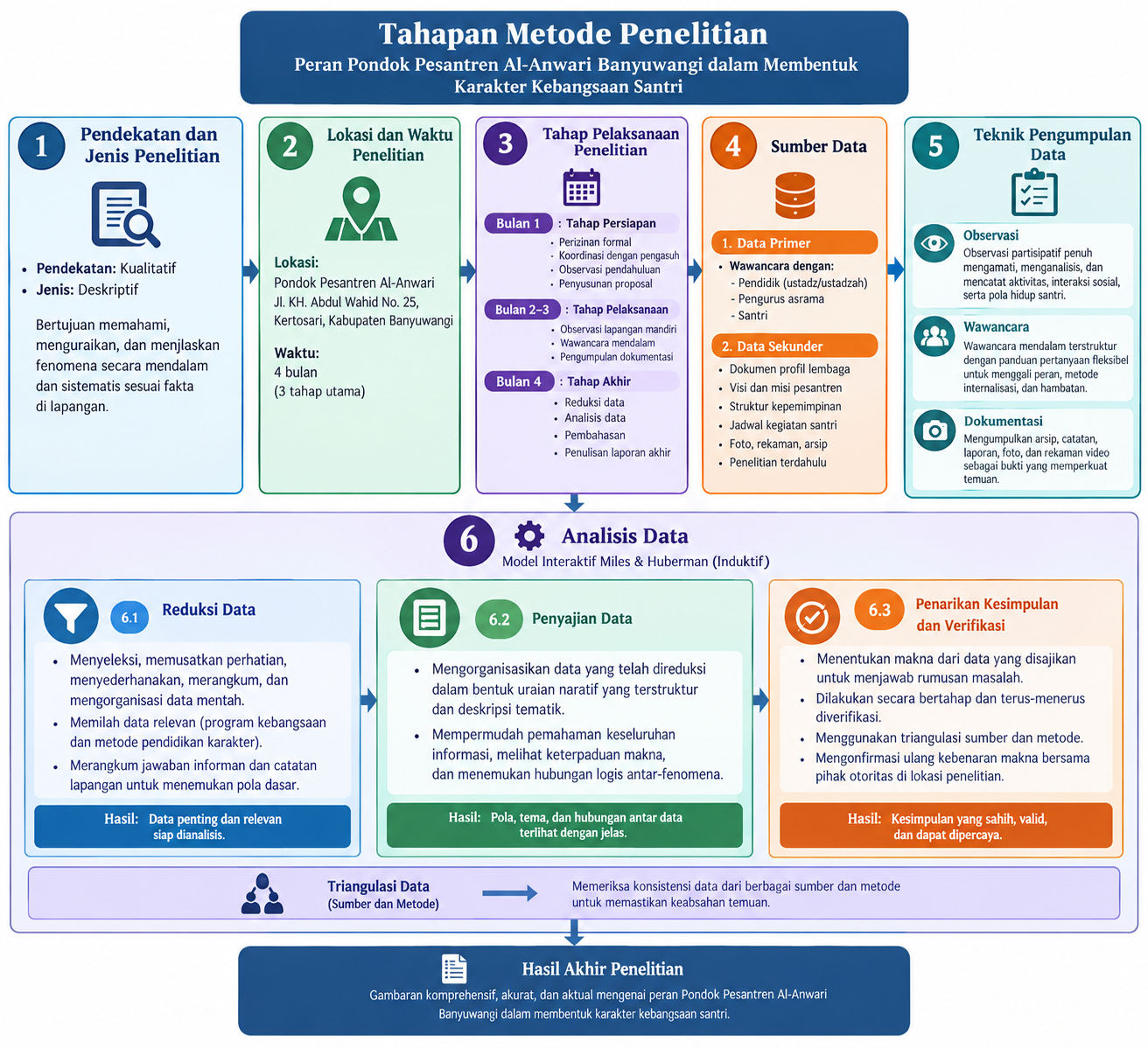
An Islamic boarding school (*pondok pesantren*) is an educational institution that goes beyond teaching religious studies; it also plays a strategic role in shaping the character of its students (*santri*), including their national character. This study aims to examine the role of the Al Anwari Islamic Boarding School in Banyuwangi in fostering the national character of its students, as well as the factors that facilitate or hinder this process. The study employs a qualitative approach with a descriptive method. Data were collected through observation, interviews, and documentation. The research subjects include religious teachers (*ustadz* and *ustadzah*), boarding school administrators, and both male and female students at the Al Anwari Islamic Boarding School. Data analysis was conducted through data reduction, data presentation, and conclusion drawing. The findings indicate that the Al Anwari Islamic Boarding School plays a crucial role in shaping the national character of its students. This is achieved through religious instruction integrated with national values, the exemplary conduct of the teachers, the enforcement of discipline, the cultivation of an orderly lifestyle, and various communal activities—such as collective work (*gotong royong*)—that foster togetherness. The national values instilled include discipline, responsibility, tolerance, unity, cooperation, and patriotism. Facilitating factors for this character development include the institution's commitment, the exemplary behavior of the educators, a conducive environment, clear institutional rules, and consistent supervision and guidance from the administrators. Conversely, hindering factors include the influence of the external environment, the use of social media, the diverse backgrounds of the students, the initial adjustment period upon arrival, and the habits students held prior to enrolling. Nevertheless, these challenges can be addressed through consistent and sustained guidance. Thus, the Al Anwari Islamic Boarding School in Banyuwangi plays an effective role in shaping students who possess not only a religious character but also a sense of national consciousness and nationalism—qualities that serve as a foundation for their lives within society, the nation, and the state.
References
Abdussamad, Z. (2022). Metode penelitian kualitatif. Syakir Media Press.
Ansori, A., Kamil, M., & Hufad, A. (2023). Santri entrepreneurial model and its implementations as community empowerment programs. Journal of Nonformal Education, 9(2), 241–250. http://dx.doi.org/10.15294/jne.v9i2.43322
Biddle, B. J., & Thomas, E. J. (2019). Role theory: Concepts and research. New York: Academic Press. (Referensi ini masuk di bagian Hasil dan Pembahasan saat menguraikan Teori Peran untuk menganalisis fungsi strategis pondok pesantren).
Creswell, J. W., & Creswell, J. D. (2023). Research design: Qualitative, quantitative, and mixed methods approach (6th ed.). SAGE Publications.
Fadli, M. R. (2021). Memahami desain metode penelitian kualitatif. Humanika: Kajian Ilmiah Mata Kuliah Umum, 21(1), 33–54. https://doi.org/10.21831/hum.v21i1.38075
Fadli, M. R. (2021). Memahami desain metode penelitian kualitatif. Humanika: Kajian Ilmiah Mata Kuliah Umum, 21(1), 33–54. https://doi.org/10.21831/hum.v21i1.38075
Firdaus, A. H., Husna, M. A., & Azizah, N. (2026). Kyai leadership drives sustainable inclusive education in Islamic boarding schools: Kepemimpinan kyai mendorong pendidikan inklusi berkelanjutan di pesantren. Indonesian Journal of Education Methods Development, 21(1). https://doi.org/10.21070/ijemd.v21i1.1006
Helaluddin dan Hengki Wijaya. (2019). Analisis Data Kualitatif: Sebuah Tinjauan Teori & Praktik. Makassar: Sekolah Tinggi Theologia Jaffray. (Referensi ini masuk di bagian Metode Penelitian pada sub-bab teknik analisis data kualitatif model interaktif).
Irwanto, I., Rumahlewang, E., Kamali, A. S., Halimah, L., Prayugo, A., Putra, H. S., Fajar, A., Widya Astuti, E. R., Setiyono, A., Herudiati, S. E., & Athalarik, F. M. (2026). Metodologi penelitian kualitatif: Pendekatan konseptual dan operasional. Widina Media Utama
Kango, A., Perdana, D. A., & Biya, S. R. (2021). Developing ethics for 'santri' empowerment: The case of the Pesantren al-Falah of Gorontalo, Indonesia. Jurnal Pemberdayaan Masyarakat: Media Pemikiran dan Dakwah Pembangunan, 5(1). https://doi.org/10.14421/jpm.2021.051-02
Miles, M. B., & Huberman, A. M. (1994). Qualitative data analysis: An expanded sourcebook (2nd ed.). Thousand Oaks, CA: Sage Publications. (Referensi ini masuk di bagian Metode Penelitian dan Hasil Pembahasan untuk memperkuat teori reduksi data, penyajian data, dan penarikan kesimpulan).
Moleong, L. J. (2021). Metodologi penelitian kualitatif (Edisi Revisi ke-8). Bandung: Remaja Rosdakarya. (Referensi ini masuk di bagian Metode Penelitian untuk memperkuat instrumen pengumpulan data melalui wawancara mendalam yang terstruktur).
Mujib, A., Yunita, Y., & Bachri, S. (2021). The roles of pesantren and madrasah in modern society. AJMIE: Alhikam Journal of Multidisciplinary Islamic Education, 2(1). https://doi.org/10.32478/ajmie.v2i1.701
Mutaqin, M. T. I., & Khadavi, M. J. (2026). Integrasi pembelajaran pesantren dalam membentuk santri interpreneurship. Paedagogie, 21(1), 879–892. https://doi.org/10.31603/paedagogie.v21i1.16126
Siswanto, S., Luthfi Hakim, M., Asrofi, S., & Sirril Wafa, M. (2026). Fiqh sosial as a conceptual framework for pesantren-based community empowerment: Insights from Kiai Sahal Mahfudh. Santri: Journal of Pesantren and Fiqh Sosial, 7(1), 89–104. https://doi.org/10.35878/santri.v7i1.2353
Sugiyono. (2019). Metode penelitian kuantitatif, kualitatif, dan R&D. Bandung: Alfabeta. (Referensi ini masuk di bagian Metode Penelitian untuk mendefinisikan perolehan data primer serta model penyajian data kualitatif).
Published
How to Cite
Issue
Section
Copyright (c) 2026 Zakiyatul Warda, Mohammad Sabiq Irwan Hariandi, Desi Yunita Putri

This work is licensed under a Creative Commons Attribution-ShareAlike 4.0 International License.